Key takeaways:
- Current mining challenges are amplifying the impact of operational underperformance in mining productivity and value
- The economic and operational impacts of asset underperformance are often not fully understood
- Asset management needs to shift from a traditional maintenance function to a strategic value driver centred on performance and operability
- A structured diagnostic methodology can be used to identify and address performance challenges through benchmarking assets, management systems, operational processes, and support team capabilities against the highest standards achievable in the industry
- This diagnostic approach can help mine owners gain clear insight into areas of underperformance, their root cause and opportunities for improvement
The new mining reality
The mining industry is facing a convergence of challenges that are placing increasing pressure on asset productivity and operational performance. Ore grades continue to decline, requiring more material to be processed to achieve the same production output. Many mines are also now operating for longer periods, relying on aging assets that are more prone to breakdowns, have lower utilisation rates, and higher maintenance costs. Mining operations are also becoming increasingly remote, creating further challenges, from spare parts supply chains to workforce access.
In addition, these challenges are compounded by an aging and increasingly expensive workforce, slow and uneven adoption of new technologies and ongoing market price volatility. Growing sustainability requirements are introducing stricter energy and water constraints, necessitating more complex planning and operating approaches. Supply chain disruptions and increasing complexity further exacerbate the situation, driving critical parts shortages and equipment downtime.
Collectively, these factors amplify the impact of operational underperformance, with seemingly minor inefficiencies often compounding into cascading failures that significantly reduce productivity and erode value. To put this in perspective: at prevailing copper prices, an operation running 5-8% below nameplate capacity could be leaving hundreds of millions (USD) in annual value on the table, highlighting the substantial cost of underperformance.
As a result, organisations must rethink their approach to asset management, shifting the focus from a traditional maintenance function to a strategic value driver centered on performance and operability. While many mine owners continue to focus largely on production growth, growing pressure to sustain productivity means they must also carefully balance the pursuit of increased output with the need to manage operational risks, minimise disruptions, and maintain consistent performance.
Aligning assets with business value
Many mine owners face the challenge of balancing asset performance with broader operational and business objectives. In some cases, the full economic and operational impacts of asset underperformance may not be clearly visible, which can make it more difficult to identify and capture opportunities for additional value across the operation.
Historically, asset management has focused primarily on day-to-day operating and maintenance activities, with emphasis on preventing issues from escalating into larger failures. While these activities are essential, they often do not provide a complete view of the broader business impact that asset performance has on profitability and long-term value creation.
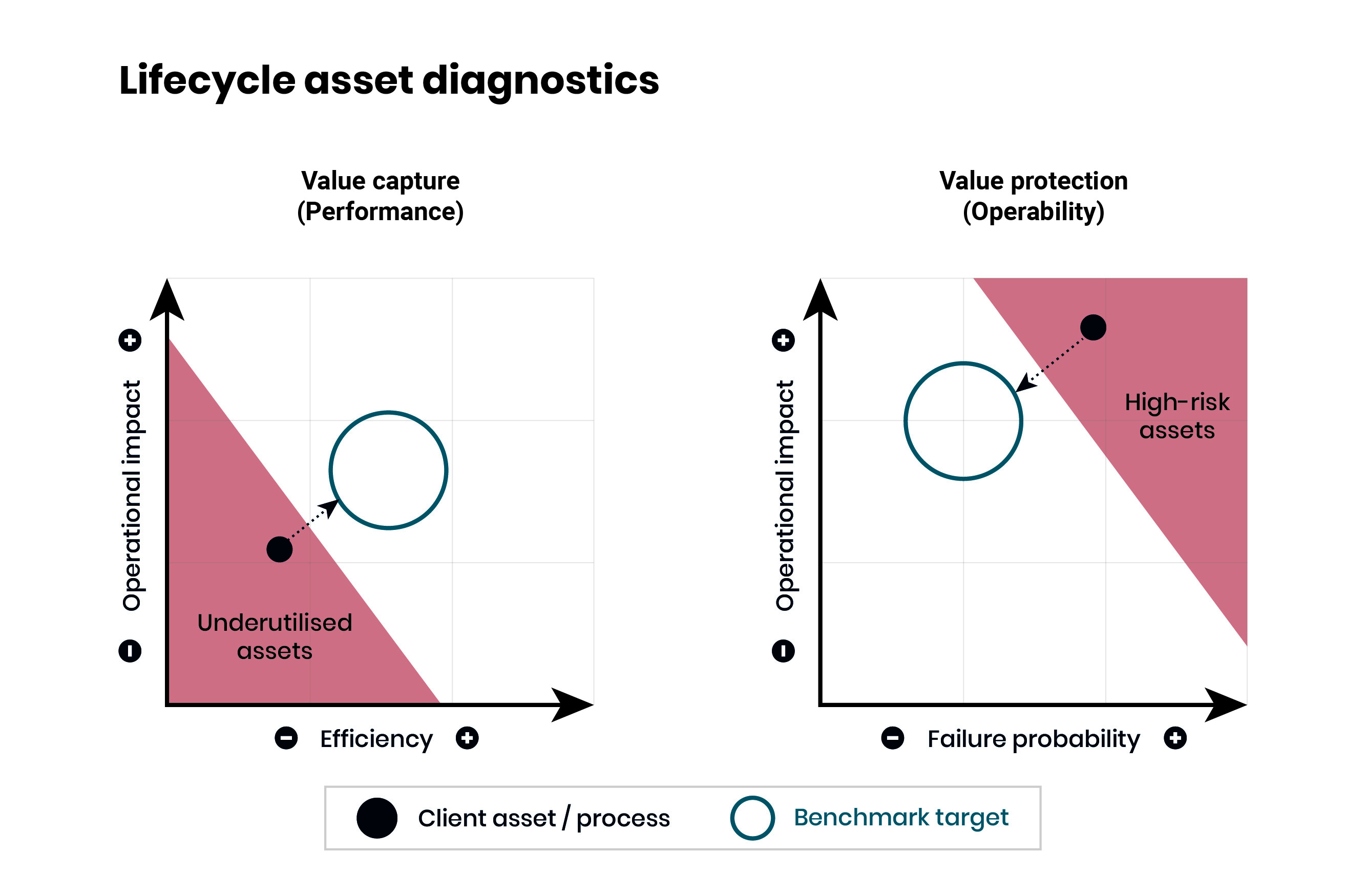
To unlock greater value, mine owners need to take a more strategic perspective on asset management. This means translating technical and operational performance into clear financial outcomes, quantifying value at risk, and using this information to guide capital and operational decision-making. Success depends on achieving both high asset performance (by capturing the maximum possible value from assets), and operability (safeguarding that value over time). This helps protect both capital investments and the underlying business case.
Rethinking asset performance and operability
Ausenco combines strategic advisory capabilities with deep technical engineering expertise, bringing more than 20 years of experience delivering asset management and operational readiness programs. Our team can deliver both strategic and economic framing that translates technical decisions into financial outcomes, and the engineering depth to deliver on our recommendations. By considering operations, processes, systems, and people together, we help mining organisations develop solutions that are both practical and sustainable. Our focus extends beyond project delivery to achieving sustained performance and operability improvements that generate meaningful business results.
To determine the full economic and operational impacts of asset underperformance, our team uses a structured diagnostic methodology to identify and address performance challenges within our clients’ operations. We begin with a focused diagnostic assessment, typically completed within two to four weeks, that benchmarks critical assets, management systems, operational processes, and support team capabilities against the highest standards achievable in the industry, while also quantifying the economic impact of identified gaps. Performance benchmarks focus on equipment availability and utilisation, overall equipment effectiveness, and throughput vs. design capacity. Operability benchmarks focus on asset reliability, maintenance plan compliance, maintenance cost, and equipment condition/remaining useful life. Through this analysis, we help our clients gain clear insight into areas of underperformance, the root causes driving those issues, and the opportunities for improvement that deliver the greatest value.
Using the diagnostic findings as a foundation, out team then develops a tailored improvement program that aligns technical services with our clients’ specific needs and priorities. The results are presented through a structured stakeholder workshop that builds alignment across the organisation. By linking technical findings directly to financial outcomes, we provide clients with the information needed to make confident, data-driven decisions.
Unlocking sustainable value through asset performance
As mining operations navigate increasing complexity, maximising value from existing assets has become just as important as pursuing production growth. Organisations that can clearly understand the operational and economic impacts of asset performance are better positioned to improve productivity, reduce risk, and make more effective investment decisions. By combining engineering expertise, operational insight, and value-based decision making, Ausenco helps clients transform asset management from a maintenance-focused function into a strategic capability that drives sustainable performance, strengthens operational resilience, and delivers measurable business outcomes.